Showing posts sorted by relevance for query stamp game. Sort by date Show all posts

Thursday, October 18, 2018

Stamp Game - Static and Dynamic Addition

Today, Nito worked more with the stamp game.  He learned the concept of dynamic addition.  For those of you who are new to the stamp game, it is simply an extension or moving more from the concrete to the abstract.  This material allows for the introduction of how to write the problem on paper along with using symbols.  Like other addition and subtraction work, we will have static and dynamic equations for the child to practice.  Static equations do not involve carrying or borrowing.  Therefore, dynamic equations will involve the child carrying into the tens, hundreds, or possibly thousands column for addition.  Regarding subtraction, this might entail the child having to "Borrow" from his neighbor "Mr. Ten", or "Mrs. Hundred" to find the answer.  Below is an example of each:

STATIC ADDITION:

Here is a picture of the set of equations that we use for the stamp game.  It breaks the equations up for the child depending on what they are working on.  The answers are on the back which help create independence for the child.
 
The stamp game can be used for all four operations (addition, subtraction, multiplication, and division).  This is the material, which again is color coded for the child. Hence, green is for units, blue for tens, red for hundreds, etc.

The stamp game also has specific paper to make it easier for the child, but you could easily make this yourself or use graph paper.

Here is what the equation card looks like.  Again, these equations are fantastic because they are color coded for the child.

I have Nito write out his problem on the paper before he begins to set up his material on his felt mat. 

Here is the problem laid out in the beginning.  He first sets out the top number. 

Then he lays out the second addend underneath.  (If you click on the picture, the card with the number will be easier to see.  I'm sorry if there is a glare.) 

This picture shows that he starts with the units.  So he pushed his 1 unit up with his 8 units since he is adding.  Then he counted all of his units again to find that he had 9 units altogether.  

Then he recorded his answer for the units.

Then he continued with the tens, and so on.

Recording his answer as he goes.
 
When he is done with the problem, he turns the equation card over to check his answer.  Yay!  He got it right.  (The SG in the left hand corner indicates Stamp Game.  We have additional equations for the Golden Bead Material (GBM) in the same box so it is helpful to have them labeled.)

DYNAMIC ADDITION:


Nito set up his problem in the same manner as if doing static addition.  He laid out his first addend.

Then he laid out the second addend below.

He pushed his 6 units up with the 7 units.  Then he starts to count them.

He stopped when he got to 10 and then replaced the 10 green unit squares with a blue 10 square shown above.

Now the blue 10 unit was put at the bottom of the tens column and the units column now has the remaining units, which is 3.  He then recorded the 3 units on his paper.

He continued with pushing the tens together, counting, and recording his answer.
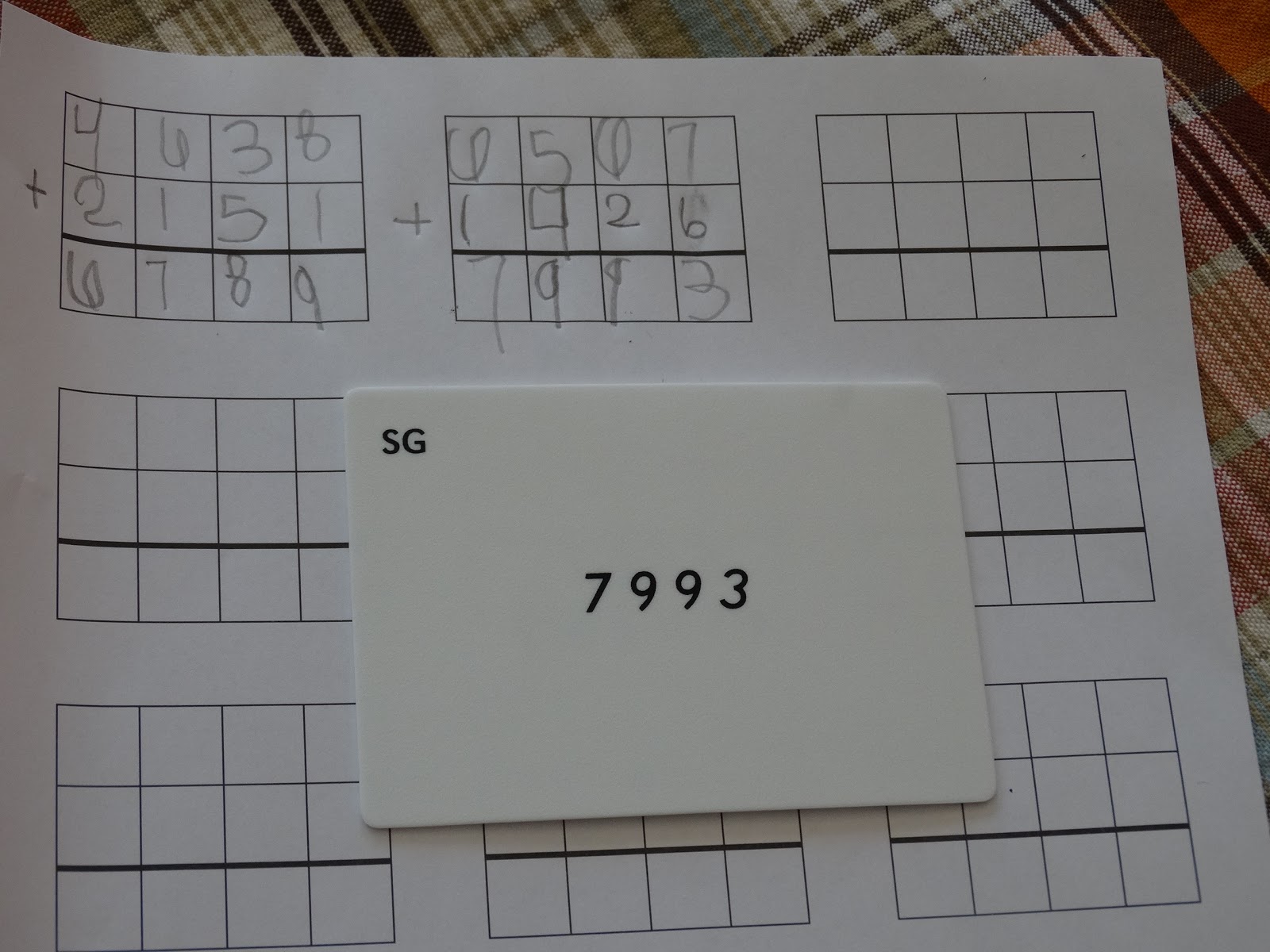
 
When finished, he checked his answer.


Thursday, February 13, 2020

Stamp Game - Division

Today, I showed Bubs how to do long division using the stamp game.  He practiced writing it down on paper as well.  He tried to jump straight to paper and was struggling a bit, so we brought out the stamp game for reinforcements.  He has pretty much mastered racks and tubes and feels like the stamp game is "baby" work and actually started crying like a "baby" today when I told him to go get it off of the shelf!

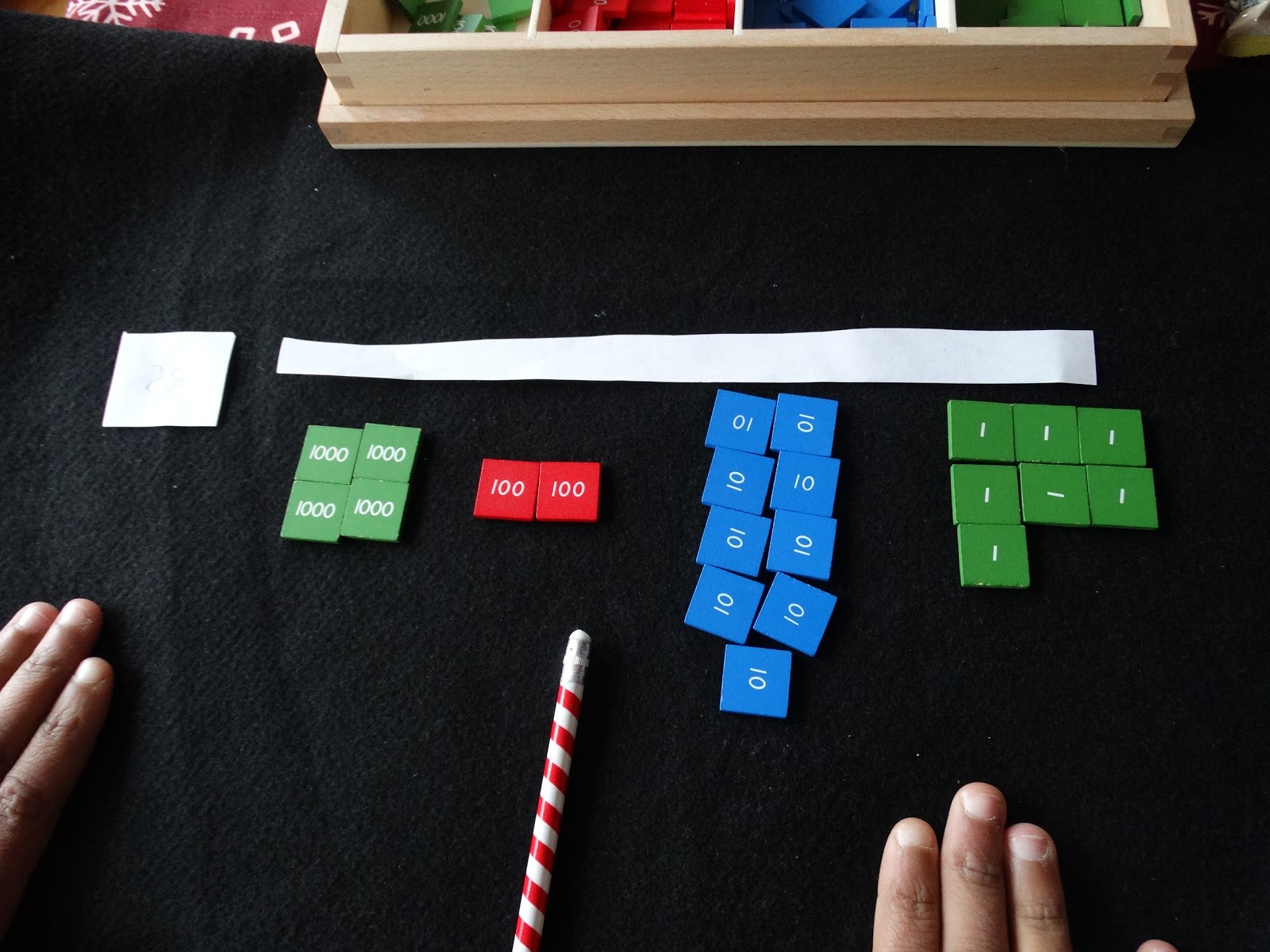
Once we moved past all of the tears, he set up his problem.  He divided 4,297 by 28.  The white strip is his division bar.  He lays out all of the tiles for the dividend and writes the divisor on a piece of paper.  (Sorry, the picture doesn't show the number on the white paper very well.)

He uses his button (the green circle above the division bar) to keep track of which category he is working on.  He then asks himself the question, "How many groups of 28 can I make with 4 thousands?"  His answer is zero.

He moves the button over the hundreds category.  The thousands and hundreds get pushed together.  Then he asks his question again.  "How many groups of 28 can I make with 42 hundreds?"  He now needs to exchange one of his thousand tiles for 10 red hundred tiles.

He exchanges his tile and then makes one group of 28.  His remaining tiles are 1 thousand tile and 4 hundred tiles.  

He records his answer on his paper.  He put a 1 above the 2 in his dividend.  He asks the question of how many did he use.  The answer is 28 of 42.  His remainder is 14.  This should match the amount of tiles he has left over.  Ideally, he writes his number on a blank ticket and places it in the correct category column above the division bar along with recording it on his paper.

The button is now moved over the ten category column.  At this point, thousands, hundreds, and tens need to be pushed together.  Remember, since the divisor has two digits, he can only have two different colors, or categories to work with.  He will need to exchange his green thousand tile for 10 hundred tiles.

"How many groups of 28 can I make with 140 tens?"  He starts sharing the tiles and comes up with 5 groups.  He has 9 tiles left over.  Bubs records his answer on his paper.


Now he brings down his final category of units to meet up with his tens that were remaining.  

He shares all of his tiles and is left with 13.

Records it on paper.

This is what the final problem should look like all laid out.  You can see how the categories end up at the bottom by the time you reach the units so the child can visualize that the number needs to be "brought down".  Oh my...just seeing those random pencils in the picture again.  Bubs!  He was obsessed with getting those in the pics.

Friday, January 24, 2020

Small Bead Frame

This presentation seemed to get passed by with my older three kids, but I sat down and purchased the ACTUAL small bead frame for T-Man and the other 3 siblings after him.  I was on a tighter budget back then and had more pressing materials to buy rather than a small bead frame.  I mean, we have the large one, so can't we just use that?!  The short answer is yes, but the longer answer is no.  Clearly Maria Montessori created a smaller one for a purpose right?

The smaller frame introduces the child to addition, subtraction, and multiplication.


The first step in introducing this new material to the child is to compare the beads to the stamp game.  Hopefully the child has experience with the stamp game and would know this comparison.  Show the child that the green 1 unit tile from the stamp game is the same as 1 green unit bead on the frame.  Do this for all four categories.  This is where it is very helpful to have the small bead frame compared to the large one!  There is a lot less explaining about how the child would need to ignore the bottom few rows of beads since the large bead frame goes up to 1 million.
 
Now the child needs to know how many beads are on each line.  Count the beads, one at a time, while pushing them to the right.  
 
 Then slide the 10 units back to the left and tell the child that 10 units is equal to 1 ten.
Now, push 1 ten to the right hand side.  Continue counting tens (1 ten, 2 tens, etc.) and exchange for a hundred bead.  Do the same through the thousands.


T-Man worked with static addition problems for a day or two before he quickly wanted to move along to dynamic addition.  Unfortunately, I didn't take pictures of his static addition.  For an example of static vs. dynamic, see this post from the stamp game.  Short story, static involves simple addition, while dynamic involved carrying of the numbers.  

He started by writing his equation on his small bead frame paper.  His equation is 9+7.

He moved 9 green (unit) beads to the right side of the frame.

Then he started adding 7 to the 9 green beads.  He pushed 1 bead over and stopped because he was at 10.  Then he pushed all 10 green beads back to the left and then moved 1 blue (ten) bead to the right.  He went back up to the green beads and continued counting with 2, 3, etc. until he got to 7.  

Now he took his pencil and recorded how many green beads he had.  He wrote down 6 on the green line under the units column.  He then recorded how many blue beads he had (1) and wrote it on the blue line, or the tens column.  
Here is what his answer looked like when he is done.  

He worked for awhile.

Here are more of his equations.  We will move on to larger equations in the next few weeks.  I'll try to update this post and add pictures.  


Wednesday, October 3, 2018

We are BACK!

So....it has been quite some time since I have posted.  Another baby has joined our family and we are still in a waiting game with our classroom.  It is under construction AGAIN!  This time, we are putting tile down to avoid any more delays in our schooling if our cool pipe wants to burst again.  I have to admit that it is quite frustrating and a huge disruption to our school year.  However, I am trying to stay patient and joyful in the meantime.  So, for awhile, the pictures that I post will be from my main living area, not the classroom.  Once we are back in business, I will post a new tour of the classroom. 

Just to keep you up to date, here is a run down of the ages of children we have:
Kui - Upper Elementary
Bubs - Lower Elementary
Nito - Primary/Transitioning into Lower Elementary
T-Man - Primary
Mumbs - Toddler
The baby - Infant

Let me first tell you that homeschooling Montessori is quite the challenge, but it absolutely can be done.  I have met my fair share of challenges, but the connection with the materials and the children always bring me back to why I do this in the first place.  For example, I was in sort of a slump with the classroom situation, but I was able to present T-Man the spindle rods, Nito the stamp game, Bubs the number base board, etc. and I instantly had my joy back!  My husband even commented on how joyful I was that day when he was working from home. 

I hope to break down some new presentations this year, especially for Elementary.  In the meantime, here are a few pictures from the week.

T-Man is working on the cards and counters.  

Mumbs is doing what every other toddler does.  Destroys the environment!  Who doesn't love a good game of matching up the color tablets after they have been dumped upside down?  Actually T-Man saw these later and sorted them all out.  So, maybe there is some good that comes out of the chaos?!?!

Kui is doing some good ole review on the decimal board.  

Bubs is working on an outline using our writing program, IEW.  See that post here.

T-Man's work with the number rods and cards.  I think he had some help from Bubs (who was trying to get out of his own schoolwork!).