Showing posts with label Elementary - History. Show all posts

Sunday, September 4, 2016

Story of Civilization


Yay!  The Catholic version of Story of the World!  For those of you who have read my previous post on Story of the World, you might be confused by my sudden excitement with another History Curriculum that is essentially the same thing.  Well, if you are Catholic, like us, this is a very huge deal.  We were about to dive into Volume II of SOTW (Story of the World), but were warned of how that might affect the way you have to teach those years of history.  Short story, it's not very Catholic and we don't want to spend the majority of our time explaining to our kids the differences and defending our faith when we shouldn't have to.  Let's wait for the kiddos to get a little bit older for all of those good times to start rolling through!

We have been using this for about 5 weeks now and I am pleasantly surprised with how similar it is to SOTW and how the kids have really taken to it.  Kui especially loves the chapter video summaries because at the end, there are quizzes, image reveals, word searches, etc. that she likes to figure out.

The set that we purchased is for Volume I and includes the following:
  • Paperback book
  • Teacher's Manual
  • Activity Book
  • Test Book
  • Dramatized audio book with over 7 hrs. of listening
  • Video Lecture Series on each chapter
  • Laminated Timeline

 
This is the timeline which provides a great visual resource for the kids.  Sorry, the timeline is big and was hard to fit the entire thing in the picture.
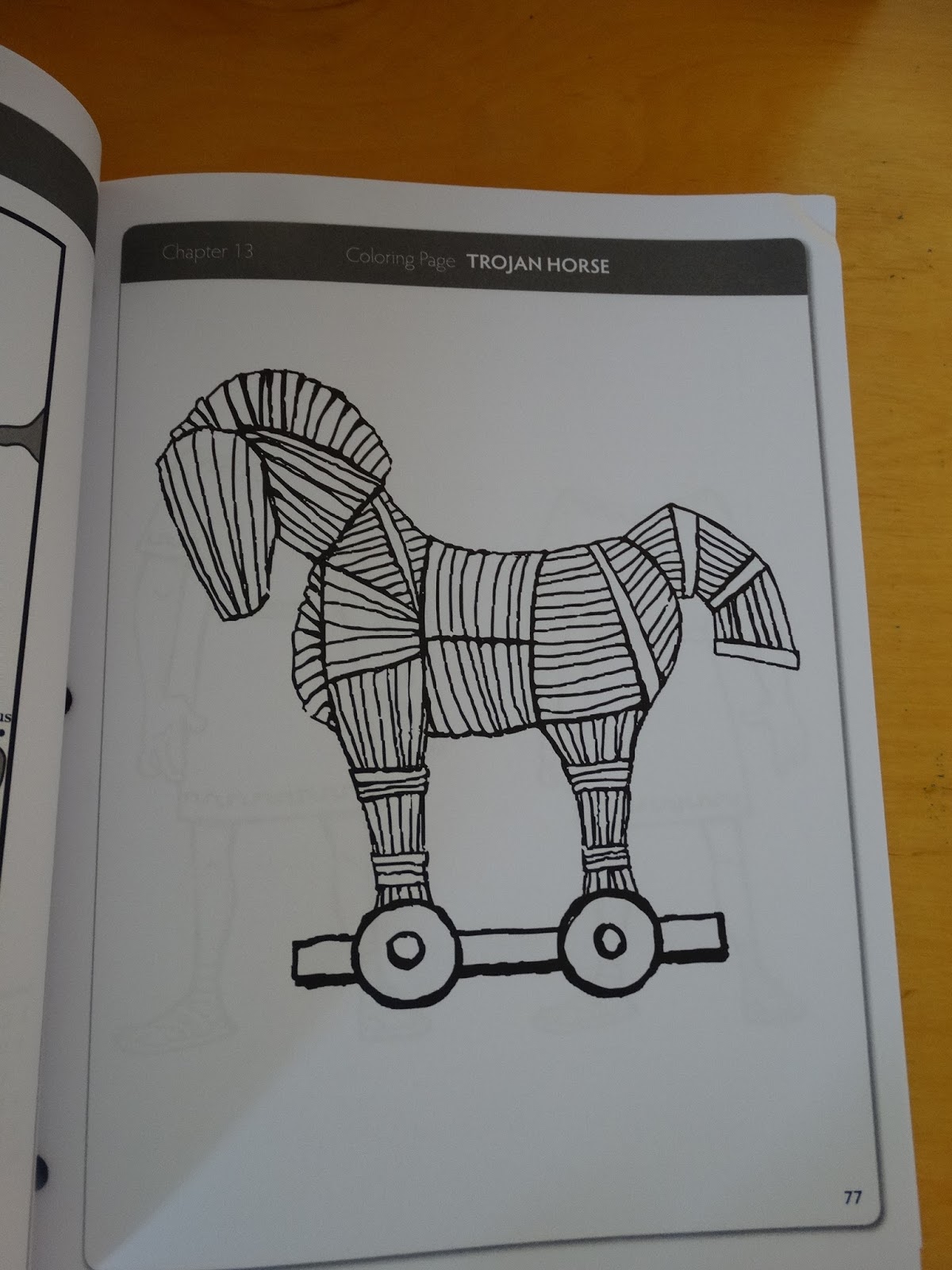
Here is a sample of what you will get in the Activity book.  It provides different maps, crafts, crossword puzzles, etc. that correspond to the different chapters.  This is from the chapter about the Trojan Horse.  The child can color this and then follow the instructions and make an actual Trojan horse with the cutouts from the two pictures below.


This is a sample of one of the maps so that the children can learn a little geography and know what part of the world each event happened.  The Teacher's manual gives you guidance on how to navigate the map.  The child may have to find a specific river and trace it in blue or find a certain city and circle it in red. 


Thursday, January 21, 2016

History Question Charts

Well what do ya know?  I stumbled across this draft buried in my files somehow!  I thought I would complete it and get it posted for those who are curious as to the follow up from this post. 
 

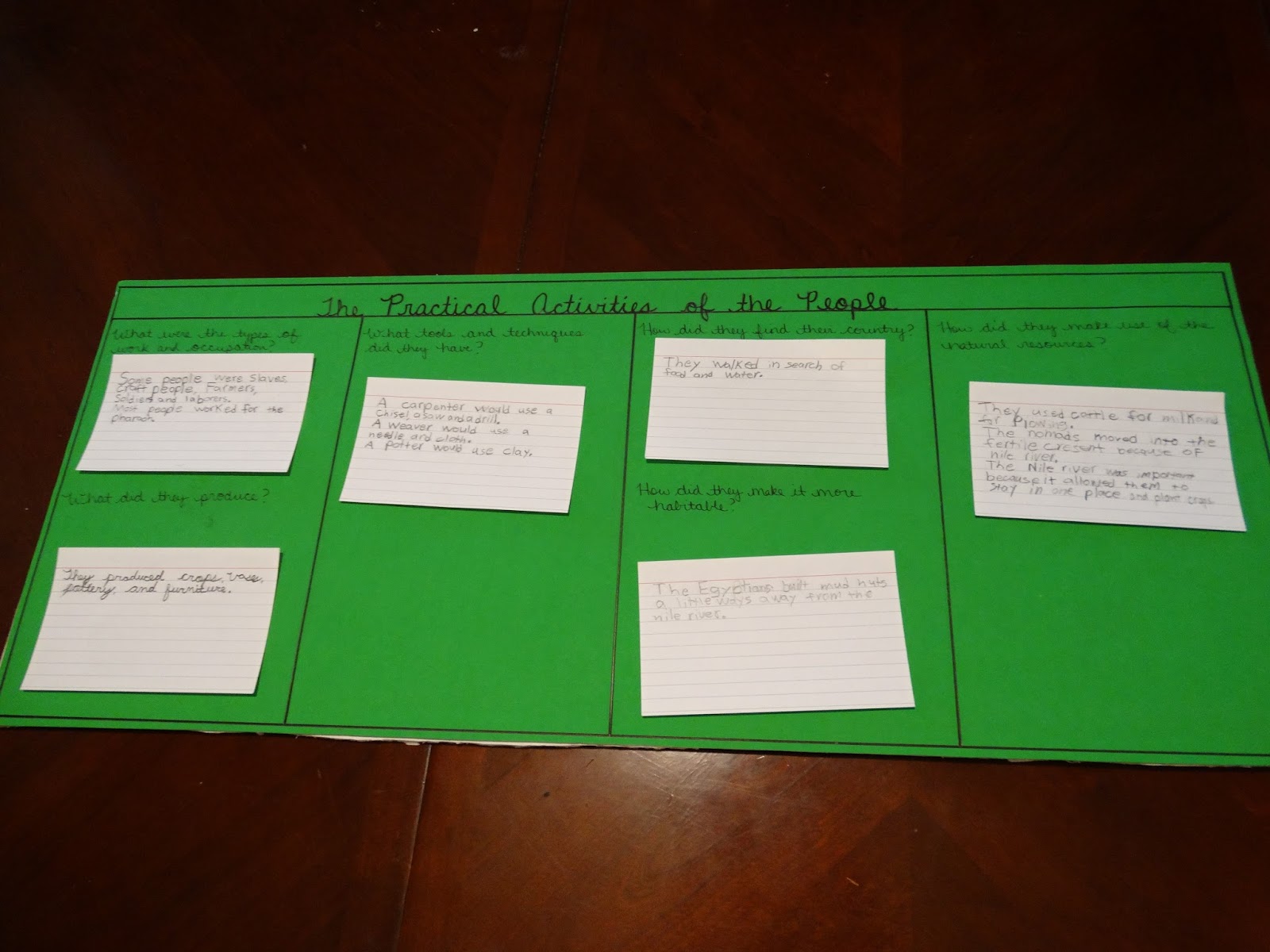
This picture show how the charts stack nicely for a shelf.  It is hard to see in this picture the size of the individual charts.  See below for more pictures.
 
 
We have really been diving into SOTW (Story of the World) lately.  I think it has to do with how much I love it and how it flows across the different subject areas very well.  My only drawback is that I can't keep up with all of the library books needed for additional reading!  Our library doesn't have every book so I have to wait a day or two for them to get it from another library.  Kui is really enjoying it though. 
 
The following pictures are the History Question Charts from the Keys of the Universe (K of U) album that I use for Elementary.  My Boys Teacher at her blog has a great explanation on these charts and a description of how Maria Montessori has encouraged drawing while listening to history by the use of audiobooks.  SOTW has this option.  I currently use the book (because I had no idea that the audiobook would be such a great idea).  I know that Kui would thrive off of that because she begs me for SOTW almost daily.  She also reads so many history books from the library and is learning so much just through that. 


Unfortunately, the four colors that came in the pack of foam board were not ideal.  The blue is very dark.  Kui can see the questions when she is close up, but it is a little challenging.  I will have to search for another color and make this one over before Bubs moves up.  Let me add that to my ever growing to do list!
 
 
 The picture below shows Kui using her library books to help her answer some of the questions about Egyptians that she learned about through SOTW.  She was not a fan of how many questions were on the charts, but was excited when she started figuring out the answers and understanding how it all worked together.

The picture will enlarge when you click on it.  She places her index cards under the individual questions.  Sometimes there are no answers and the resources that she has does not give them to her.  She just moves on.
 
 
One thing that I am realizing is how many more resources we need in the classroom.  I am trying to incorporate as many books, encyclopedias, etc. to help with her additional research, but am finding it hard.  We want her to know how to use "old fashioned ways" of finding the answer to things instead of typing it in Google.  (Like her teacher does!)  Please comment if you have any suggestions.  Right now we only have a few types of dictionaries, an atlas, and an encyclopedia. 
 

Sunday, November 15, 2015

B.C. /. A.D. Timeline


First off, I want to apologize for not posting as often these days.  We are in the midst of packing to move into a new house.  I am super excited, but it is a lot of work.  I will post pictures later in a few months with our new classroom setup.  We will have a separate space for our atrium which will be very nice.  It will be good to have a dedicated space for that.

Ok on to the B.C./A.D. Timeline!

Kui and I have been talking about the books of the Bible and how it is split up into different sections. For those that are not aware, the Catholic Bible contains 73 books while the Protestant Bible only contain 66 books.  There is a great article here, explaining why 7 books were removed from the Protestant Bible by Martin Luther in the 16th century.  We have discussed the first 5 books (Pentateuch) along with the next 11 books (Historical Books) and are currently talking about the next 5 books which are referred to as the Biblical Novellas.  It is quite interesting to be learning these things along with my child.  Such a great gift and blessing of homeschooling! 

I'm sure you are thinking, great, but what does this have to do with B.C. or A.D.?  Well in our Story of the World study for history, we have already touched upon this and what each stands for.  B.C. stands for Before Christ.  B.C.E. is also used and stands for Before Common Era.  (Of course Kui then asks why it doesn't stand for Before Christ Era.  I didn't have the answer.  It was a very good question though.  Please comment if you know why.)  A.D. stands for Anno Domini.  However, most people think it stands for After Death. So she learned this, but we never really went into further detail about how the centuries are calculated and that one era counts up and one era counts down.

So....I made this simple timeline for her so she could visibly see the difference and where the beginning of our calendar began, with Jesus Christ's birth.  I put a picture of the nativity in the center and built the B.C. and A.D. centuries to the left and right of it.  I explained to her that there was a monk named Dionysius Exiguus who was a Roman scholar and theologian who was best known for his creation of a calendar that led to the modern Gregorian calendar.  Then Kui jumped up and ran off!  I was intrigued as to where she was going because I didn't think she had ever heard of this monk (or really even cared)!  Boy was I wrong.  She came back with the book, Story of Clocks and Calendars.  She had found the page with the story of the monk and told me that she recognized that name when she heard me say it.  I was impressed.  I mean, she actually reads those books I put on the shelf?!  This is GREAT.


We also reviewed over how long a century is and talked about how B.C. centuries start from a larger number and count down until they reach 1 A.D.  Then the A.D. centuries count up, the numbers get larger. 


Friday, August 28, 2015

Story of the World - Volume 1

 
History........my ultimate nightmare and the one subject I dreaded the most as a kid growing up.  I mean, who cares about all of those ancient people and their Gods, spears, and armor anyway?  Ok that was a little harsh.   I'll apologize to all of those history buffs and lovers out there but the thought of history really does leave a bad taste in my mouth for whatever reason......until I discovered Story of the World by Susan Bauer.  Granted, we are only in Chapter three of Volume 1, but I am already in love with how she presents the information and makes it intriguing for the children. After all, the second plane child loves to hear a good story.  This is how you capture their attention and then let their imagination run free.

For those of you who are not familiar, Story of the World, it is a four volume set ranging from the Ancient Nomads to Modern Age.  There are several formats from paperback to audiobook.  Susan Bauer also provides a great resource with the Activity book.  Included in this for each chapter are additional literature resources to find at the library, review questions and several activities to go along with the current chapter.  It is actually quite awesome and I have learned a lot so far.  It is so great to be able to learn along with my daughter.


These two pictures are of a "cave painting" that Kui needed to do as one of the activities for the chapter on the Earliest people.  She was to try and create a painting like a prehistoric man would on a cave wall.  Her picture is of a goat with two people carrying bows and arrows trying to kill it for food.  She struggled with the technique that she was supposed to use, but overall I think she got the general idea that these prehistoric men would leave messages on the walls.
 

This is an example of a coloring sheet from the activity book.  The earliest nomads turned into farmers and created a leather bucket to capture water for watering their crops.
 

Our next step down the history trail is to utilize our history question charts.  Stay tuned for a post on our progress in learning about the Egyptians through the use of SOTW (Story of the World) and these charts.