Tuesday, February 4, 2020

Distributive Law for Multiplication

Nito was shown another presentation in the sequence for Distributive Law for Multiplication.  It seems that I have never posted anything for the Commutative Law, which is usually a prerequisite for this presentation.  I'll have to get on that!  However, I do show at the end of this presentation how to check your answer using the Commutative Law.

As I mentioned above, he has done the presentations on the Commutative Law, the exchanging of the multiplier with the multiplicand.  For this presentation, I chose a sum of two numbers for the multiplicand.  In the picture above, I chose 5 and 2. Since I am considering it a sum, he puts parentheses around the two bead bars. He will take this sum 3 times.  He uses a brown 3 card and places it on the outside of the parenthesis.  Ok, now ideally the child uses a gray card, but all I had on hand was brown construction paper when I made these materials.  I mean, who has time to drive 45m-1 hour round trip to Michael's with 6 kids just to get gray paper?!  Honestly, it doesn't matter the color paper, as long as it isn't white.

This is the box of bead bars that he uses.  It is a bit different from the checkerboard bead box because this one includes the ten bars.

What does taking this sum 3 times mean?  It means taking the 5 bar 3 times and the 2 bar 3 times.  The blue beads are the 5 bars and the green are the 2 bars.

Then the value is calculated and placed underneath the respective columns (15 and 6).

Then the beads are pushed together.

Now, the beads are exchanged to make a single number of 21.

Commutative Law Check
Since the child knows the commutative law, he can check his answer.  It says if you exchange the multiplier with the multiplicand, then you should get the same answer.  Nito laid out the problem after exchanging beads for tickets and tickets for beads.  In the picture above, the distributive law is on the left hand side and the commutative law is on the right hand side.  He laid out a 3 bead bar and now has a 5 and 2 brown card inside the parentheses. 

He begins by taking the 3 bead bar 5 times and then takes it 2 times.  He finds the answer and places the single number below.

This picture shows that the commutative law on the right hand side has an answer of 21 which matches his distributive law answer of 21.  His work checked out!


Friday, January 24, 2020

Small Bead Frame

This presentation seemed to get passed by with my older three kids, but I sat down and purchased the ACTUAL small bead frame for T-Man and the other 3 siblings after him.  I was on a tighter budget back then and had more pressing materials to buy rather than a small bead frame.  I mean, we have the large one, so can't we just use that?!  The short answer is yes, but the longer answer is no.  Clearly Maria Montessori created a smaller one for a purpose right?

The smaller frame introduces the child to addition, subtraction, and multiplication.


The first step in introducing this new material to the child is to compare the beads to the stamp game.  Hopefully the child has experience with the stamp game and would know this comparison.  Show the child that the green 1 unit tile from the stamp game is the same as 1 green unit bead on the frame.  Do this for all four categories.  This is where it is very helpful to have the small bead frame compared to the large one!  There is a lot less explaining about how the child would need to ignore the bottom few rows of beads since the large bead frame goes up to 1 million.
 
Now the child needs to know how many beads are on each line.  Count the beads, one at a time, while pushing them to the right.  
 
 Then slide the 10 units back to the left and tell the child that 10 units is equal to 1 ten.
Now, push 1 ten to the right hand side.  Continue counting tens (1 ten, 2 tens, etc.) and exchange for a hundred bead.  Do the same through the thousands.


T-Man worked with static addition problems for a day or two before he quickly wanted to move along to dynamic addition.  Unfortunately, I didn't take pictures of his static addition.  For an example of static vs. dynamic, see this post from the stamp game.  Short story, static involves simple addition, while dynamic involved carrying of the numbers.  

He started by writing his equation on his small bead frame paper.  His equation is 9+7.

He moved 9 green (unit) beads to the right side of the frame.

Then he started adding 7 to the 9 green beads.  He pushed 1 bead over and stopped because he was at 10.  Then he pushed all 10 green beads back to the left and then moved 1 blue (ten) bead to the right.  He went back up to the green beads and continued counting with 2, 3, etc. until he got to 7.  

Now he took his pencil and recorded how many green beads he had.  He wrote down 6 on the green line under the units column.  He then recorded how many blue beads he had (1) and wrote it on the blue line, or the tens column.  
Here is what his answer looked like when he is done.  

He worked for awhile.

Here are more of his equations.  We will move on to larger equations in the next few weeks.  I'll try to update this post and add pictures.  


Color Changing Activity


T-Man has been working with the color tablets lately.  I decided to let him experiment making secondary colors from the primary colors.  

He started with putting a droppers worth of yellow dye in the small bowl.  

 
Then he added a dropper of red dye.

I think I took this picture before he stirred, but it will be orange.

Next, he put a dropper of red dye in the second bowl to create another secondary color.

Then he added a dropper of blue to the red bowl.

He took his handy dandy stirring spoon and discovered that he just made the color purple!  He giggled and was so excited.

Now, he took a dropper of yellow in the third bowl.

Added a dropper of blue.

Voila!  Green.

Here are the three secondary colors he made.  

The fourth bowl is for experimenting.


Wednesday, November 6, 2019

School days


Bubs was working on positioning of lines and types of angles today.

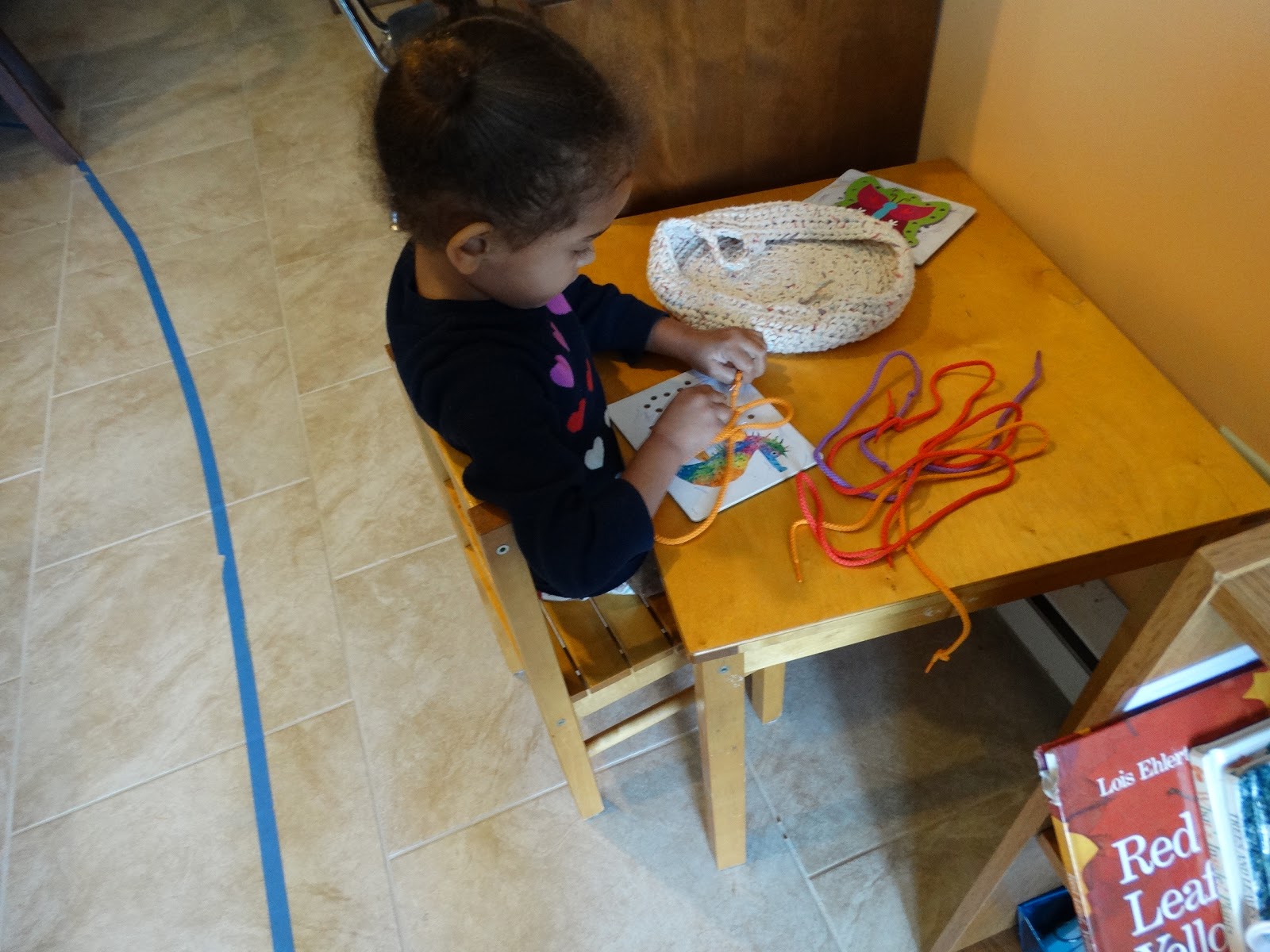
Mumbs took a stab at lacing.

Nito working on the distributive law of multiplication.
 
T-Man working on handwriting with the sand tray.  

Bubs loves these snap circuits!  He has been working on some new engineering/coding material that I should hopefully be posting about soon.  

Mumbs loves the smooth/rough boards!

Nito was presented lines today.  This is a terrible angle, but the blue water represents the horizontal line like what you would see if you are looking out at the horizon while on the beach.  He could easily visualize that since we went to the beach a few months ago.
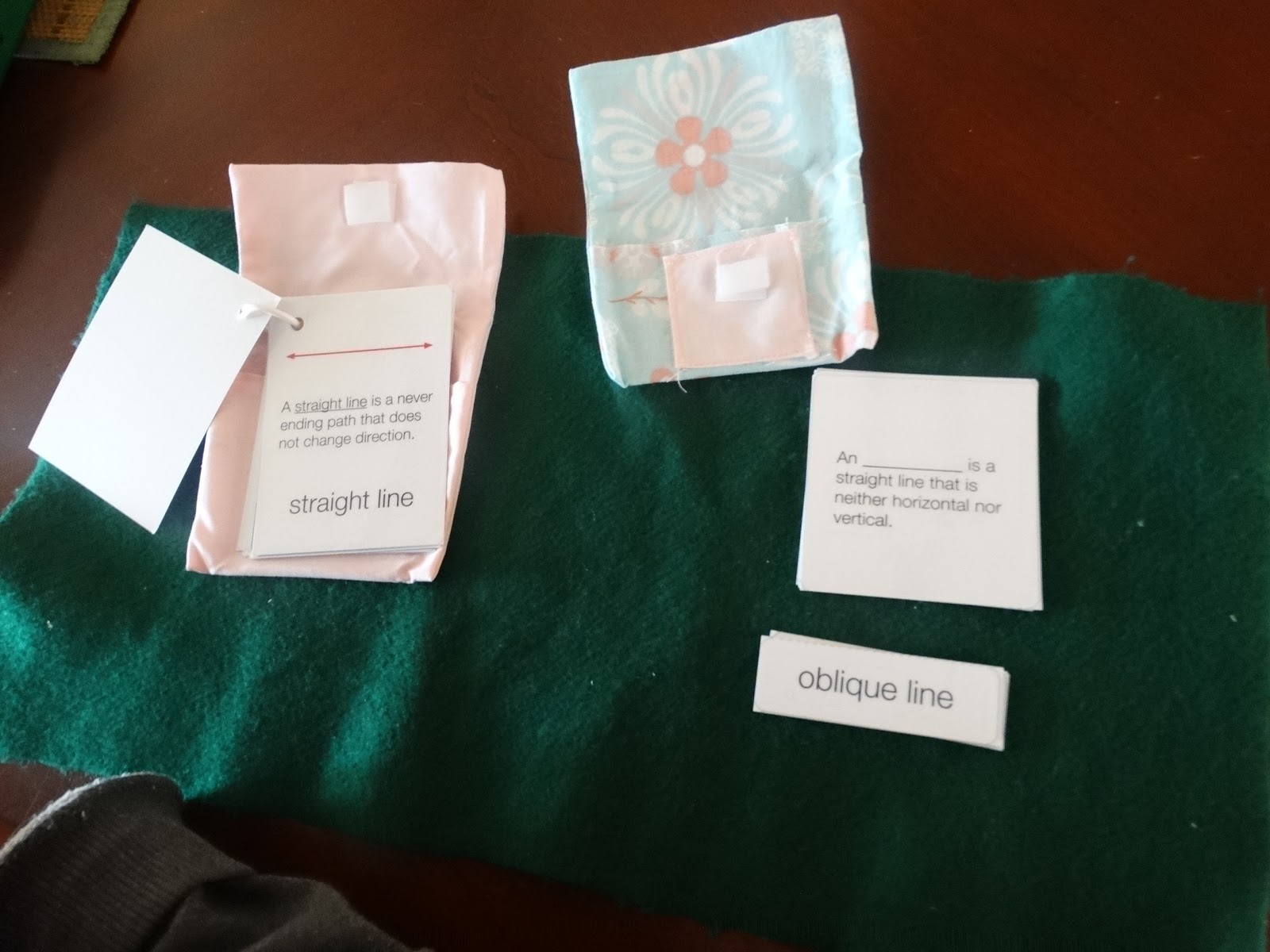
The follow up to his presentation was the nomenclature booklets.
Sorry this picture is blurry.  He tried his best to match them up.  He still needs some practice on this one.  Thankfully he can check the control booklet because I can't remember all of those things!

T-Man was finally shown watercolors.  He was so excited to be able to use the materials that he always sees his brother doing.  
 
Of course it didn't take Bubs long to get out his version of painting after he saw T-Man.

Nito started working on homophones.  He was able to name quite a few not on this list.  I think he got this pretty easy and we can move on.

I introduced the idea of magnetism to Bubs.  The first lesson was just the idea of the magnetic force and then he went around the room with his clipboard trying to stick magnets to everything.  He recorded his answers on his table.  It was super cute.  He looked all official!  All he needed was a pencil behind the ear to pull off the look!

Nito was shown addition of fractions.  Oh my goodness, for anyone who knows how animated Nito is, they would appreciate this.  We did 1/4 + 1/4.  He came up with the answer of 2/4.  Then as part of the presentation he is supposed to see if any larger fractions fit within the space on the inset (which teaches reduction of a fraction).  So he checked thirds, no.  He checked halves, YES!!  He jumped out of his chair and starting laughing, "Ha Ha Ha Ha".  He was so excited that it fit.  You can only guess his enthusiasm when he reduced 1/4 + 3/4.  Yes, it equals 1 whole!!  

Mumbs working on the binomial cube.  Does it ever surprise anyone else when you come to see your child working "next to" the work rug instead of actually on it?!  I mean, I guess I have to give her credit for getting one out.  Now, I just need her to actually use it.

Because this guy is perfectly chill not using a work rug at all.  I got this crazy, wild, colorful rug to add some fun and color to the classroom, but I don't see how they can actually see their work without a work rug, especially something like color tablets!

T-Man working on the addition strip board.  Man......I didn't have the heart to tell him that his strips were not going to fit at that particular desk.  He is so stubborn sometimes and has to learn the hard way.  Well.....he did when they all started falling off.  He threw himself on the ground and started crying.  It was actually quite comical and we all started laughing.  Then he busted out laughing and we moved him to a work rug with much more room to spread out.