Wednesday, March 11, 2020

Sensorial Exploration of Distributive Law

Nito was presented with an extension of the Distributive Law today.  This brought in the idea of arithmetic exploration.  I apologize in advance for these pictures.  I didn't really how bad the glare was until I put them on the computer.  So, for your reference, the brown cards are 3 and 5 respectively.
The first set of parentheses has the 7 bar and the 2 bar that he will be multiplying by the brown 3 card and the 5 card.  

He first turns over the brown 5 card so that he can multiply both bead bars by the brown 3 card.  He then places his beads below.  

Now, he turns the brown 3 card over and multiplies by the brown 5 card and places the beads below on the right hand side.

He then totals the individual columns and places that below.

He pushes all of the beads together.

Then he simplifies and trades in beads for the final answer.  He ends up with the answer of 72.

CHECK USING COMMUNICATIVE LAW

So the great thing with the Montessori way of learning is that the child always has some way to check his answer.  He doesn't really have to rely on the teacher to know if his answer is correct or not (which is great because I'm not always available!)  For this problem, he can check his work using the communicative law.  

Nito basically just flip flops the beads and the cards.  He now has the 3 and 5 beads on the left with the brown 7 and 2 cards on the right.  The same process is done as before.  The brown 2 card gets turned over and the bead bars get multiplied by the brown 7 card with the answers being placed below.

The brown 7 card is flipped over and now the bead bars will be multiplied by the brown 2 card, placing the beads below.

Sum the columns individually.

Push all of the beads together.

Simplify and trade the beads in for the final answer.  72!  Yay, his answer checks out.

Monday, March 2, 2020

Global Cuisine - Israel

Mmmmm.....it all started in the early morning with Sufganiyot stuffed with dulce la leche and delicious tea.  DJ managed to whip out some Israeli donuts before Mass today.  I'm not sure how he manages to pull all of these things off, but he did and they were delicious.  

Kui wrote down all of the menu items for us this week.  Time was not on DJ's side by late afternoon for all of these and the cauliflower didn't make an appearance.  The baba ganoush made a late appearance very close to dessert and I actually don't have a picture.  It resembles a hummus that you can eat with pita bread for those who are interested.  It is made out of eggplant.  Interesting.... is really the only word I have to describe it!

Israeli Salad
I was put on a few tasks this Sunday since some last minute things popped up at church for DJ.  This was one of them.  Lots and lots of chopping, but it was well worth it.  This salad had tomatoes, cucumber, red and yellow bell pepper, red onion, fresh mint and parsley, lemon zest and lemon juice.  A great fresh element to the dinner for sure.  Kui, who would rather eat a snake than tomatoes, said she actually liked this.  Woohoo!!

Squash Gallette
Another task I was put on.  Let's say that this was definitely a first for me.  I have never made a dough using coconut oil and I think I never will again.  It was not the consistency I was expecting and very hard to work with.  I think I sort of pulled off what the pictures look like online!  Don't mind the hunk missing in the crust at the top of the picture.  DJ tore off a hunk to taste it and I said, "Seriously, I didn't get a pic first!"  This gallette has butternut squash, carrots, apple, and red onion.  It has a maple syrup and lemon drizzle.  
 
Falafel on pita with tahini sauce
Here is a picture with everything mixed together.  The way my hubby likes to eat it.  There is falafel made from chickpeas, tahini sauce made from sesame seeds, the salad, and some filling from the gallette.  


DJ showing you how to eat it (or perhaps he was just about to take a bite and I thought he was posing for me!)

Marzipan Chocolate Rugelach
Hmmm....as I'm writing this, I'm sensing a pattern.  This was also one of my tasks.  Now what did DJ actually make for Israel one might ask?!  Apparently it was the falafel and tahini sauce.  But hey, that's how it goes some weekends depending on what is going on.  We are all part of a family and many of the children pitched in to help cook or clean the dishes.  Ok back to the yummy dessert.  This was very time intensive and I would have preferred it been made with milk chocolate rather than dark, but very good though.  

The children had costumes and a play all ready, but then a certain child decided to cause drama for everyone and everything was called off by the head honcho in charge, Kui!  She called it off once one of the cast members left and so we have no pictures or a play to show for Israel.  However, the kids did have a surprise visitor, their pediatrician made a house call!  Mumbs has not been feeling well so her doctor stopped by after Mass and it ended up being perfect timing for dinner.  She joined us for dinner and made our night special.  They shared all about our tradition and the previous countries that we have done. 

Next week, Portugal!  Stay tuned.

Thursday, February 20, 2020

Geometric Multiplication


Today I reviewed the concept of geometric multiplication with Bubs.  It is a simple multiplication problem, but the child draws it on graph paper and color codes it.  The problem he started with was 3,748 x 53.  


He first started with drawing the multiplicand of 3,748.  He started in the bottom right hand corner of the paper and made a dot.  Then he counted eight units to the left for the first number of his multiplicand.  He made another dot.  The length of that line represents eight units so he drew a line to connect the dots and wrote an "8" underneath the line.

He continued for the remaining categories of his multiplicand.


Here is the multiplicand graphed on paper.


Next he drew the multiplier.  He started with the same dot as the 8 for the units at the bottom right hand corner of the paper.  However, now he will move upwards counting vertically, instead of across the paper horizontally.  The unit of the multiplier is 3.  He counted up 3 lines and drew a dot.  Connect the lines and write a 3 to the right of the line.  This length represents the three units of the multiplier.  He connected all of the dots to make a rectangle.  He is multiplying so he will multiply the units by the units to get some amount.  How much is 8 x 3?  24.   This equation is written in the rectangle and then colored green for units.


He continues for the remaining categories and colors them according to their category: blue for tens, red for hundreds, and green for thousands.   You should be able to click on the picture to enlarge if the picture is too small.


Now, he moved to the next row vertically to multiply the 50 tens. He multiplied 50 x 8.  That gave him 400 units.  He marked the lines vertically and created another rectangle.  Then he colored it green for the units.  

He continued with the remaining categories in the second row.


The final step is to calculate his answer.  He looked at the products of each area of the diagram and added them together.  He recorded his answer as he added each category.


Monday, February 17, 2020

Global Cuisine - Venezuela

Here is our menu for our Venezuelan Cuisine.
Ok, so since I don't take pics of my kids faces (see why here), I had to figure out a creative way to get a picture of their costume.  I tried a profile pic here.  I only captured the boys for this meal because the girls were still showering and getting dressed and then our guests arrived.  For their costumes, we used kangas from Kenya, a sombrero from Mexico, and for some reason, my daughter chose to get T-Man an Australian outback hat.  I didn't say anything though because she tried! HA.

Ok, so before we delve too deep into this global cuisine tradition, I would like to throw out a disclaimer that we usually don't buy any clothes/accessories for our dinners.  We simply use what we have at home to try to recreate the outfits the best we can.  So, I hope we don't offend anyone that may be reading from a particular country!  That is not our intention.

The table is a great example of how we improvise.  A lady I used to work with is from Guatemala and gave me this table runner.  I decided to use it for Venezuela since it looked close enough!

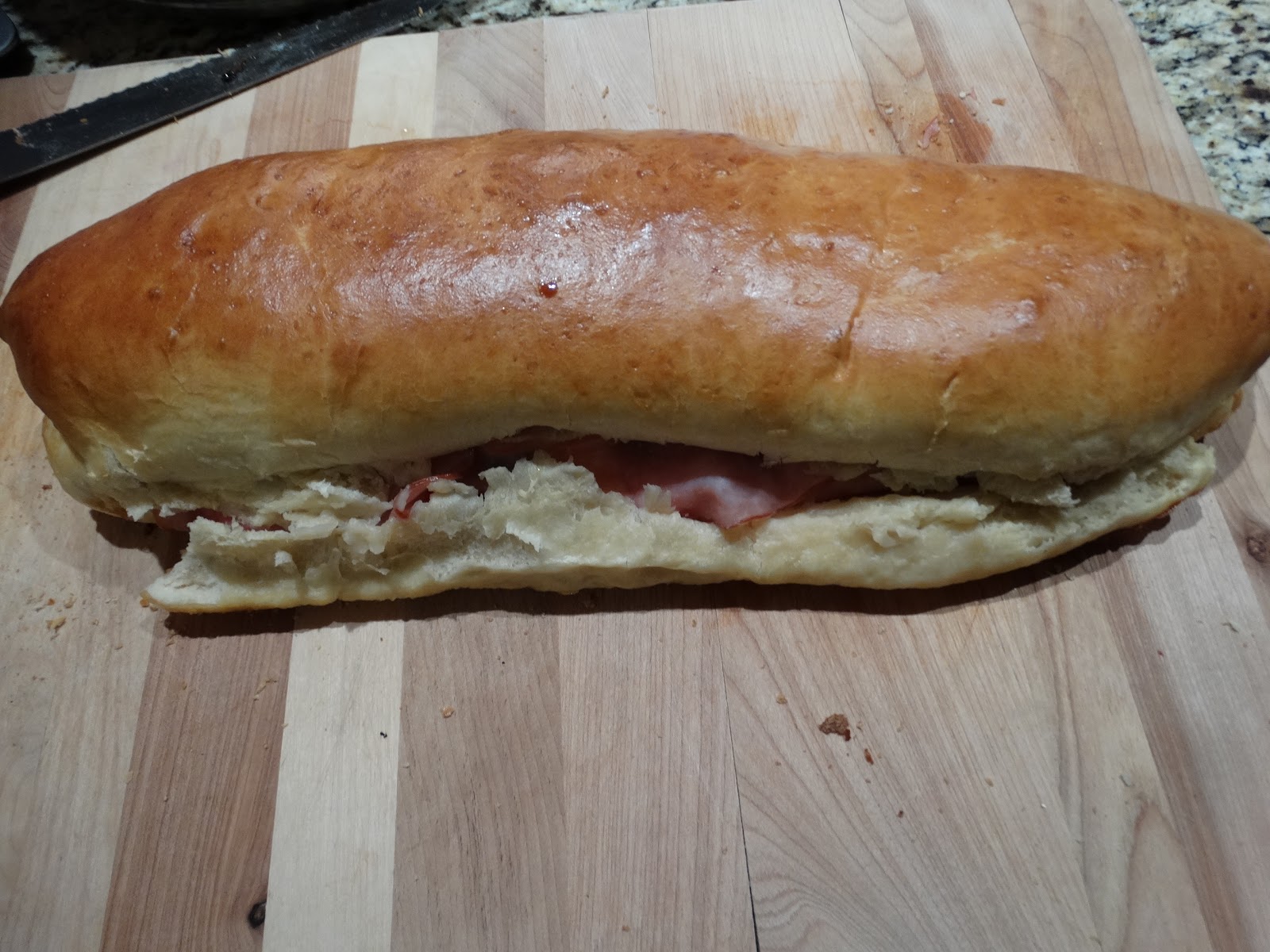
 Our dinner started with Venezuelan Pan de Jamon as an appetizer.  My husband knows that I'm not a fan of olives, so he left those out of this.  He only put raisins and ham.  He also burned the palm sugar and opted to use maple syrup as a substitute.  The kids came running into the kitchen and told him enthusiastically that something was burning!  It was his palm sugar!!  He still pulled it off and it was a huge hit!
 
Our really good friends and our son, Bubs' Godparents, came over for dinner.  They brought the traditional Venezuelan rice drink called Chicha.  It was delicious.  She added ice, the drink, cinnamon, and a cinnamon stick for added flavor and for stirring.  Apparently, this drink was made by mothers and given to their kids after school to hold them over until dinnertime.  

Here is a picture of the rest of the meal.  It included Venezuelan Sweet Plantains, Pabellon Criollo (shredded skirt steak), Bollos Pelones (ground beef dumpling with leeks, olives, capers, and many other ingredients), Venezuelan beans and rice, and a cilantro mojo sauce to put on pretty much anything.

Dessert was a Chocolate Marquesa.  It is a layered cake with maria cookies and premium baking chocolate.  Let me just tell you that my darling husband makes great desserts, but the kitchen looked like a bomb went off after this.  My kitchen aid mixer was covered with cocoa powder, smeared butter residue, drippings of dried sweet condensed milk, and a dusting of powdered sugar!  I guess it was worth it in the end.  

I attempted to cut it nicely for a picture, but it sort of fell apart.  Not sure that it set for the 8 hr in the fridge.  It still tasted delicious.

The kids ran out of time to perform their song, but I did get books from the library and the older ones read about Venezuela.  Every week doesn't quite go as planned, but we always have a great time and love listening to the different music from each country.  The main point is that we are building a tradition of having dinner as a family on Sundays and exposing our children to different cultures.  

Thursday, February 13, 2020

Stamp Game - Division

Today, I showed Bubs how to do long division using the stamp game.  He practiced writing it down on paper as well.  He tried to jump straight to paper and was struggling a bit, so we brought out the stamp game for reinforcements.  He has pretty much mastered racks and tubes and feels like the stamp game is "baby" work and actually started crying like a "baby" today when I told him to go get it off of the shelf!

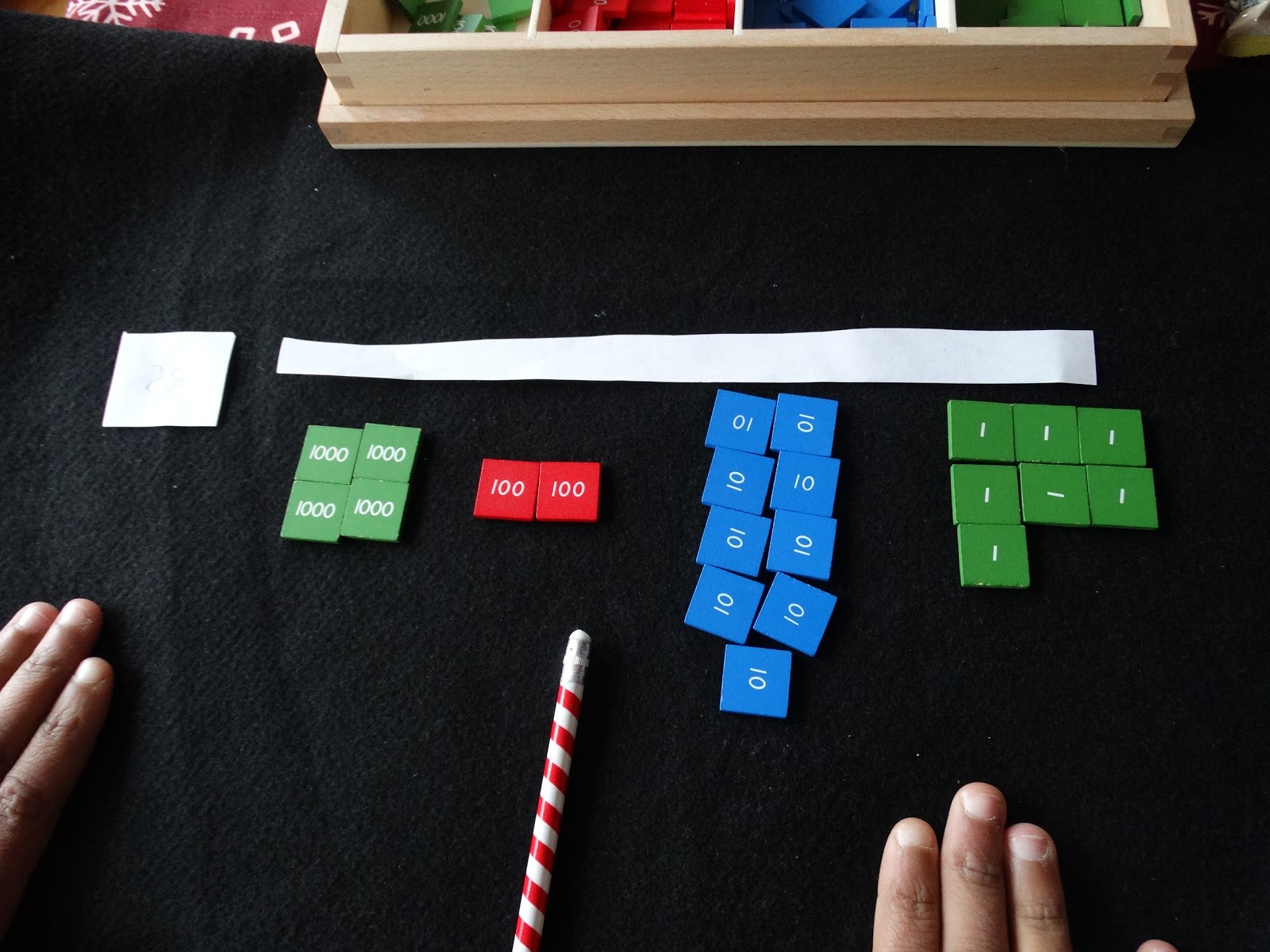
Once we moved past all of the tears, he set up his problem.  He divided 4,297 by 28.  The white strip is his division bar.  He lays out all of the tiles for the dividend and writes the divisor on a piece of paper.  (Sorry, the picture doesn't show the number on the white paper very well.)

He uses his button (the green circle above the division bar) to keep track of which category he is working on.  He then asks himself the question, "How many groups of 28 can I make with 4 thousands?"  His answer is zero.

He moves the button over the hundreds category.  The thousands and hundreds get pushed together.  Then he asks his question again.  "How many groups of 28 can I make with 42 hundreds?"  He now needs to exchange one of his thousand tiles for 10 red hundred tiles.

He exchanges his tile and then makes one group of 28.  His remaining tiles are 1 thousand tile and 4 hundred tiles.  

He records his answer on his paper.  He put a 1 above the 2 in his dividend.  He asks the question of how many did he use.  The answer is 28 of 42.  His remainder is 14.  This should match the amount of tiles he has left over.  Ideally, he writes his number on a blank ticket and places it in the correct category column above the division bar along with recording it on his paper.

The button is now moved over the ten category column.  At this point, thousands, hundreds, and tens need to be pushed together.  Remember, since the divisor has two digits, he can only have two different colors, or categories to work with.  He will need to exchange his green thousand tile for 10 hundred tiles.

"How many groups of 28 can I make with 140 tens?"  He starts sharing the tiles and comes up with 5 groups.  He has 9 tiles left over.  Bubs records his answer on his paper.


Now he brings down his final category of units to meet up with his tens that were remaining.  

He shares all of his tiles and is left with 13.

Records it on paper.

This is what the final problem should look like all laid out.  You can see how the categories end up at the bottom by the time you reach the units so the child can visualize that the number needs to be "brought down".  Oh my...just seeing those random pencils in the picture again.  Bubs!  He was obsessed with getting those in the pics.